What Happens to Your Property in Türkiye When You Die? Inheritance Guide for Foreign Owners (2026)
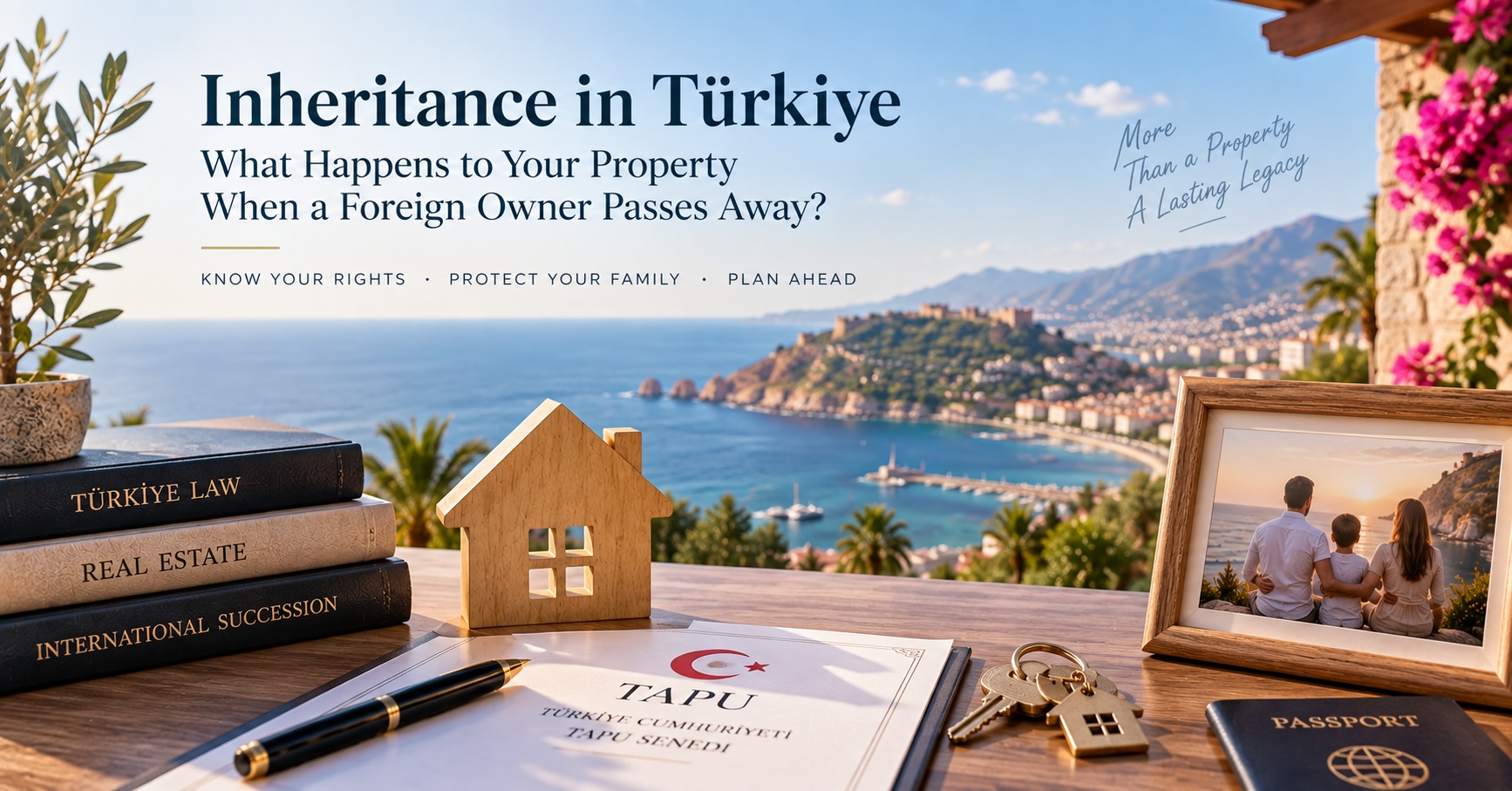
What Happens to Property in Türkiye When a Foreign Owner Dies?
Buying a home in Türkiye is often a long-term decision. For many international buyers, the property is not only a holiday home or investment but also an asset they eventually expect to leave to their spouse, children or other family members.
This naturally raises an important question:
What happens to your property in Türkiye when you die?
In general, a property in Türkiye does not simply disappear or automatically return to the state when a foreign owner dies. Real estate can pass to legal heirs, but the inheritance process must be completed correctly and the property must eventually be registered in the names of the eligible heirs.
For foreign owners, the process can involve both Turkish inheritance rules and international documentation. Understanding the basics in advance can make matters considerably easier for the family later.
In this 2026 guide, we explain the main principles foreign property owners and their families should understand about inheriting real estate in Türkiye.
Can Foreigners Inherit Property in Türkiye?
Yes. Foreign nationals can generally inherit real estate located in Türkiye.
However, inheritance involving a foreign owner or foreign heirs can be more complex than a standard domestic inheritance case.
For real estate located in Türkiye, Turkish law plays an important role in determining how the property is transferred. In addition, foreign heirs must comply with the legal rules that apply to foreign nationals acquiring real estate in Türkiye.
This means that the nationality of the deceased owner, the nationality of the heirs, the location of the property and the legal ownership records may all be relevant.
For most ordinary residential properties owned by eligible foreign nationals, inheritance can be completed through the appropriate legal and title deed procedures.
Who Can Inherit the Property?
The exact heirs depend on the individual circumstances of the deceased owner.
Potential heirs may include:
- A surviving spouse
- Children
- Other descendants
- Parents or other relatives in certain circumstances
- Persons named in a legally valid will, depending on the applicable inheritance rules
The distribution of an estate should not be assumed based only on the rules of the owner's home country.
When Turkish real estate is involved, families should obtain professional legal guidance to establish who the legally recognised heirs are and what share each heir is entitled to receive.
Does the Property Automatically Transfer to the Children?
No. The title deed is not automatically changed into the children's names immediately after the owner's death.
The heirs first need to establish their legal status as heirs and complete the required inheritance procedures.
After the necessary documentation has been obtained, the inheritance must be processed through the relevant Turkish authorities and the title deed registration must be updated.
This is an important distinction.
Having a legal right to inherit the property and being registered as the new owner at the Land Registry are separate stages.
What Documents May Be Required?
The exact document list can differ depending on the nationality of the deceased owner, where the death occurred and the circumstances of the heirs.
Documents may commonly include:
- Death certificate
- Passports or identification documents of the heirs
- Documents proving family relationships
- Certificate of inheritance or equivalent legal documentation
- Title deed information for the property
- Turkish tax numbers where required
- Official translations
- Apostille or consular certification where applicable
Foreign documents normally need to meet the formal requirements for use before Turkish authorities.
Because documentation requirements can vary significantly between countries, heirs should confirm the required documents before arranging translations or travelling to Türkiye.
If you are still at the purchasing stage, our guide on documents needed to buy property in Türkiye explains the main documents foreign buyers encounter during a real estate transaction.
What Is a Certificate of Inheritance?
A certificate of inheritance is one of the key documents in the inheritance process because it identifies the legal heirs and their inheritance shares.
When foreign nationals are involved, obtaining or recognising the appropriate inheritance documentation may require additional legal procedures compared with a purely Turkish inheritance case.
Once the heirs and their shares are formally established, the property can move toward registration in the heirs' names.
How Is the Title Deed Transferred to the Heirs?
After the inheritance status has been established and the required tax and administrative procedures have been completed, an application can be made to the Land Registry for the inherited property.
The existing title deed record is then updated to reflect the new ownership structure.
For example, if several children inherit the property, they may become co-owners according to their legally determined inheritance shares.
The heirs may then decide to:
- Keep the property together
- Allow one heir to acquire the shares of the others
- Use the property as a family home
- Rent the property
- Sell the property
If the heirs eventually decide to sell, our guide to selling property in Alanya as a foreign owner explains the main stages of the sales process.
Is There Inheritance Tax in Türkiye?
An inheritance involving property in Türkiye can create tax and declaration obligations.
The amount payable is not simply a fixed percentage of the property's market price. The calculation can depend on the taxable value, inheritance share and the applicable tax brackets and exemptions.
Because tax rates, exemptions and administrative values can change, heirs should obtain an up-to-date calculation when the inheritance process begins rather than relying on an old estimate.
Foreign property owners should also distinguish inheritance-related taxation from the regular costs of owning real estate.
For an overview of ongoing ownership and acquisition expenses, see our Property Taxes and Buying Costs in Alanya guide.
Can a Foreign Heir Keep the Property?
In many cases, yes.
However, foreign nationals acquiring property in Türkiye are subject to certain legal restrictions. Those restrictions can also become relevant when ownership is acquired through inheritance.
The situation can therefore depend on factors such as:
- The heir's nationality
- The location of the property
- The type and size of the property
- Whether the property is located in an area subject to acquisition restrictions
For a normal apartment or villa in an established residential area such as Alanya, the process is often manageable, but each inheritance should still be reviewed individually.
What Happens If There Are Several Heirs?
One property can be inherited by several people.
If this happens, the heirs may become joint owners of the property in accordance with their inheritance shares.
This can work perfectly well when the family agrees on how the property will be used.
However, difficulties can arise if one heir wants to sell while another wants to keep the home.
For this reason, international property owners with several children or heirs may benefit from thinking about estate planning while they are still actively managing the property.
Can the Heirs Sell the Property?
Yes. Once the inheritance process has been completed and the heirs have the legal authority to dispose of the property, they can generally sell it.
If several people inherit the property, the ownership structure must be taken into account when arranging the sale.
The heirs should also check possible tax consequences, outstanding property-related debts and the documents required for the title deed transaction.
Foreign owners planning ahead may also find our After Buying Property in Türkiye guide useful for understanding the practical responsibilities that continue after the original purchase.
What If the Heirs Live Outside Türkiye?
Living abroad does not necessarily mean that every stage must be completed personally in Türkiye.
Depending on the procedure, heirs may be able to appoint a lawyer or another authorised representative through a properly prepared power of attorney.
This can be particularly useful when several heirs live in different countries.
However, powers of attorney intended for use in Türkiye must be prepared in the correct form. Translation, notarisation, apostille or Turkish consular procedures may be required depending on where the document is issued.
Should Foreign Property Owners Make a Will?
A will can be useful, particularly for owners with assets in more than one country or a complex family structure.
However, simply writing that a particular property should go to one person does not mean that every other inheritance rule automatically disappears.
Inheritance law can include protected rights for certain legal heirs, and international estates may involve more than one legal system.
For this reason, foreign owners considering a will should obtain advice from a lawyer experienced in Turkish inheritance and international private law.
The objective should not simply be to create a document, but to ensure that the estate plan can actually be implemented when necessary.
Can You Buy Property in Türkiye in Your Children's Names?
Some families consider purchasing property directly in the name of a child or another family member in order to simplify future inheritance.
This should not be treated as an automatic solution.
Ownership structure can have legal, tax, family and practical consequences. The buyer should understand who will legally control the property, who can sell it and what happens if family circumstances change.
The ownership structure should therefore be decided before the title deed transfer, not as an afterthought.
If you are currently considering a purchase, start with our step-by-step guide to buying property in Alanya.
Inheritance Planning for Foreign Property Owners in Alanya
Alanya has thousands of international property owners, many of whom live in Türkiye only part of the year.
This makes basic inheritance planning particularly important.
A foreign owner should ideally make sure that family members know:
- Where the original title deed and purchase documents are kept
- The property's full address and title deed information
- Which bank accounts and payments relate to the property
- Whether there are outstanding maintenance fees, taxes or debts
- Who to contact in Türkiye if assistance is required
Good record keeping can save heirs considerable time later.
Common Mistakes Foreign Property Owners Should Avoid
One of the biggest mistakes is assuming that the inheritance process will work exactly as it does in the owner's home country.
Other common problems include:
- Family members not knowing where the title deed is kept
- Using foreign documents that are not properly legalised for Türkiye
- Delaying the inheritance process for many years
- Assuming the title deed automatically changes after death
- Ignoring tax and municipal obligations
- Giving an unsuitable or incorrectly drafted power of attorney
- Trying to sell the property before the inheritance registration has been properly completed
Most of these problems can be prevented through good documentation and professional guidance.
Frequently Asked Questions
Can my children inherit my apartment in Türkiye?
Generally, yes. Children can inherit Turkish real estate, subject to the applicable inheritance rules and the legal requirements for foreign nationals owning property in Türkiye.
Does Türkiye take the property when a foreign owner dies?
Not simply because the owner is a foreign national. The property normally forms part of the deceased owner's estate and can pass to eligible heirs after the required legal procedures are completed.
Do my heirs need to come to Türkiye?
Not necessarily for every stage. Depending on the case, certain procedures may be handled by an authorised representative using a properly prepared power of attorney.
Can several children inherit one apartment?
Yes. Several heirs can hold shares in the same property.
Can heirs sell an inherited property in Türkiye?
Generally, yes, once their inheritance rights and ownership have been properly established and the required title deed procedures have been completed.
Do I need a Turkish will?
Not every foreign property owner necessarily needs a separate Turkish will. However, owners with significant assets, several heirs or property in multiple countries should consider professional estate-planning advice.
Final Thoughts
Owning property in Türkiye is a long-term asset decision, and inheritance should be part of that planning.
For most foreign owners, there is no reason to be alarmed: real estate in Türkiye can generally pass to eligible heirs. The important point is that the inheritance must be legally established, the necessary documents must be prepared correctly and the title deed must ultimately be registered in the heirs' names.
Owners who keep their documents organised and understand the basic process make things considerably easier for their families.
If you are planning to buy, own or eventually sell property in Alanya, M² Real Estate can assist with the real estate side of the process and coordinate with the appropriate legal professionals when specialist legal advice is required.
Looking for property in Alanya? Explore our current property portfolio and contact M² Real Estate for professional assistance with your property search.
This article provides general information and does not constitute individual legal or tax advice. Inheritance situations involving foreign nationals should be assessed according to the specific circumstances of the owner, heirs and property.
Share this post: