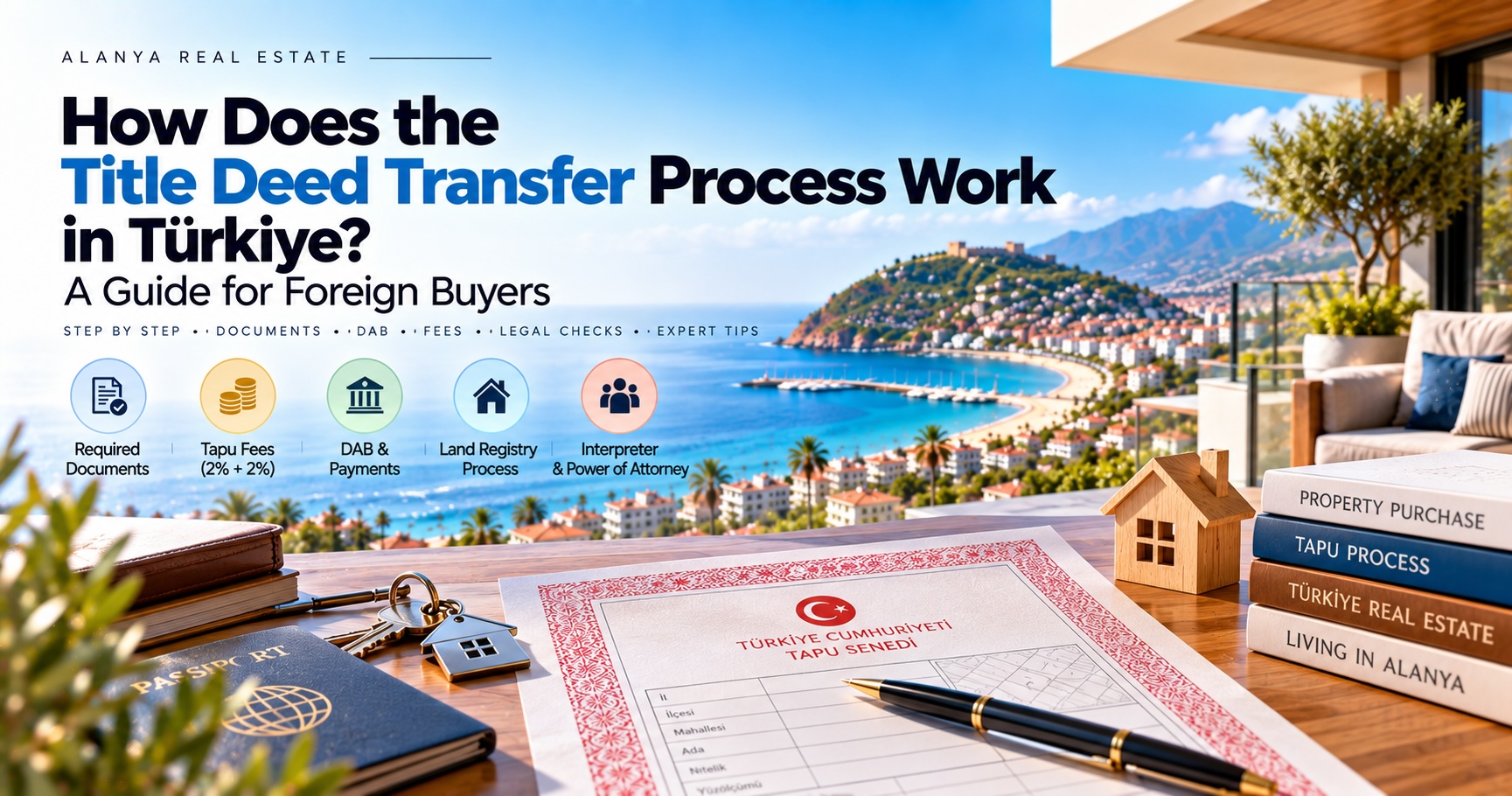
How Does the Title Deed Transfer Process Work in Türkiye? A Guide for Foreign Buyers
The title deed transfer in Türkiye is the official process that legally transfers ownership of a property from the seller to the buyer. For a foreign buyer, the process normally includes checking the property and ownership records, preparing the required documents, arranging the payment and foreign-currency documentation where applicable, submitting the Land Registry application, paying the official fees and completing the final signatures. Once the transfer is registered, the buyer becomes the legal owner of the property.
For international buyers exploring Alanya real estate, understanding this process before making a payment is important. The Turkish title deed system is highly formalised, but several steps happen before the final appointment at the Land Registry Office. Knowing who does what, when the purchase price is paid and which costs belong to each party can make the transaction much easier to understand.
What Is a Tapu in Türkiye?
Tapu is the commonly used Turkish term for the official title deed and the registered ownership record of a property.
The title deed contains important information about the property and its registered owner. The legal transfer of ownership is completed through the Turkish Land Registry system. Signing a private sales agreement or paying a deposit does not by itself replace the official transfer of ownership at the Land Registry.
Türkiye also has different title deed classifications. Buyers may encounter terms such as Kat Mülkiyeti, Kat İrtifakı and Arsa. If these terms are unfamiliar, read our detailed guide to title deed types in Türkiye before proceeding.
Title Deed Transfer in Türkiye: The Process at a Glance
For a typical foreign property purchase, the process can be understood in the following sequence:
- The buyer selects the property and agrees on the commercial terms with the seller.
- The property and ownership records are checked.
- The parties agree on the purchase price, payment schedule and who will pay the transaction costs.
- The required buyer and seller documents are prepared.
- Foreign-buyer requirements, including the applicable foreign-currency procedure, are completed.
- The Land Registry application is submitted.
- The Land Registry reviews the application and prepares the transaction.
- Applicable title deed fees and official charges are paid.
- The parties attend the appointment, or authorised representatives act on their behalf.
- The official transfer documents are signed.
- The ownership is registered in the buyer's name.
The exact sequence can vary depending on the buyer, seller, property and structure of the transaction. For a broader overview from property selection through completion, see our step-by-step guide to buying property in Alanya.
1. Agree on the Sale Terms Before Starting the Title Deed Process
Before the Land Registry application is submitted, the buyer and seller should clearly agree on the essential commercial terms.
These normally include:
- the agreed purchase price;
- the deposit, if any;
- the remaining balance and payment date;
- the currency and method of payment;
- the intended title deed transfer date;
- which party will pay each transaction cost;
- whether furniture or other items are included;
- what happens if either party fails to complete the transaction.
This is particularly important for foreign buyers because assumptions about payment timing or transaction costs can cause problems shortly before the title deed appointment.
2. Check the Property Before the Transfer
Finding an attractive property for sale in Alanya is only the beginning. Before significant funds are transferred, the legal status of the property should be reviewed.
Depending on the transaction, relevant checks can include ownership information, title deed details, mortgages, attachments, restrictions, annotations and other matters affecting the property or its transfer.
The exact checks required depend on the individual property. Our property due diligence guide for Türkiye explains this stage in more detail.
Buyers should avoid assuming that a property is legally ready for transfer simply because it is completed, furnished or currently occupied.
3. Which Documents Does a Foreign Buyer Need?
The required documents can vary depending on nationality, transaction structure and whether the buyer acts personally or through a representative.
Common requirements may include:
- a valid passport;
- a Turkish tax number or relevant identification number;
- passport translation where required;
- photographs or other identification information where required for the transaction;
- foreign-currency documentation applicable to the purchase;
- a power of attorney if the buyer is represented;
- other transaction-specific documents requested by the authorities.
Rather than preparing documents based on an old checklist, buyers should confirm the requirements applicable to their particular transaction. We explain the subject separately in What Documents Do You Need to Buy Property in Türkiye?
4. What Is the Döviz Alım Belgesi (DAB)?
The Döviz Alım Belgesi, commonly abbreviated as DAB, is an important part of many foreign-buyer property transactions in Türkiye.
Under the foreign-currency procedure applicable to foreign natural persons purchasing real estate, the relevant foreign currency is sold through a bank to the Central Bank of the Republic of Türkiye, and the bank prepares the required foreign-currency purchase documentation for the Land Registry process.
The procedure should be organised correctly before the title deed transfer. Buyers should not improvise the payment route or transfer large amounts without first understanding how the payment, bank transfer and DAB will be coordinated for their transaction.
For a detailed explanation of the payment process, read our guide to paying for property in Türkiye as a foreign buyer, including DAB and bank transfers.
5. Is a Property Valuation Report Required?
A valuation report may be relevant or required depending on the nature of the transaction and the applicable rules. It can also play an important role in transactions connected with specific immigration or citizenship procedures.
Because valuation requirements and their purpose can depend on the individual transaction, buyers should establish at the beginning of the purchase whether a valuation report is needed rather than waiting until the title deed application is already underway.
Our separate guide explains the property valuation report process in Türkiye for foreign buyers.
6. How Is the Land Registry Application Submitted?
Once the necessary documents and transaction preparations are complete, an application is made through the Turkish Land Registry system.
Türkiye's Land Registry and Cadastre system uses digital infrastructure such as Web Tapu and TAKBİS to process and manage applications. After the application is reviewed and the required information is accepted, the parties receive information regarding the next steps, applicable payments and appointment process.
A common misunderstanding among foreign buyers is that simply visiting a Land Registry Office with a passport and purchase contract is enough to transfer a property immediately. In practice, the file must first be prepared and processed through the official system.
7. How Much Is the Title Deed Transfer Fee in Türkiye?
This is one of the most important points for a buyer to understand before signing a purchase agreement.
The statutory title deed fee for a standard property sale is 2% for the buyer and 2% for the seller, calculated separately on the value used for the title deed transaction. This means the combined title deed fee is 4%.
However, there is an important distinction between the statutory allocation of the fee and the commercial agreement between buyer and seller.
Important for Alanya buyers: who actually pays the 4%?
In the Alanya property market, it is common in practice for sellers to ask the buyer to cover the entire title deed fee, including the seller's 2% share. In such a transaction, the buyer may therefore be expected to pay the full 4%, even though the statutory fee is structured as 2% for the buyer and 2% for the seller.
This is a market practice and a matter to be agreed between the parties; it should not be confused with the statutory allocation of the title deed fee.
For this reason, a foreign buyer should never assume that only 2% will be payable by them. Before paying a deposit or signing the sales agreement, ask specifically:
“Who will pay the buyer's 2% and the seller's 2% title deed fee?”
The answer should ideally be clearly stated in the sales or reservation agreement so that there is no unexpected additional cost shortly before the title deed transfer.
For example, if the value used for the title deed transaction is €200,000 equivalent in Turkish lira, the statutory structure corresponds to 2% on the buyer's side and 2% on the seller's side. If the parties agree that the buyer will cover both sides, the buyer would effectively budget for the full 4% title deed fee.
There are also other official and transaction-related expenses in addition to the percentage-based title deed fee. For a broader cost breakdown, read our guide to property taxes and buying costs in Alanya.
8. What Value Is Used to Calculate the Title Deed Fee?
The title deed fee is calculated on the value declared for the transfer, subject to the applicable minimum based on the property's official property tax value.
Buyers should be cautious if anyone suggests declaring an artificially low purchase value simply to reduce the title deed fee. The declared transfer value should comply with the applicable rules, and an incorrect declaration can create tax and legal consequences for the parties.
For a foreign buyer, this issue can also interact with bank transfers, DAB documentation and other transaction records. The figures used throughout the transaction should therefore be coordinated properly rather than treated as unrelated paperwork.
9. When Should the Purchase Price Be Paid?
There is no single payment schedule that fits every property transaction.
A resale transaction between private individuals can be structured differently from a purchase directly from a developer. A completed property can also have a different payment structure from an off-plan development.
The important point is that the payment schedule should be agreed before the transfer and documented clearly.
Buyers should know:
- how much has already been paid as a deposit;
- when the remaining balance becomes due;
- which bank account receives the funds;
- how the DAB process will be handled where applicable;
- what proof of payment will be retained;
- how payment is coordinated with the final title deed transfer.
Do not rely solely on verbal assurances for a large international property payment.
10. Does the Buyer Have to Speak Turkish at the Title Deed Appointment?
The parties must understand the legal transaction they are completing.
If a foreign party does not have sufficient Turkish for the official transaction, an authorised interpreter may be required in accordance with the applicable Land Registry procedure. The interpreter's role is not simply to provide casual translation but to ensure that the foreign party understands the official transaction being signed.
Buyers should therefore establish in advance whether an interpreter will be required and arrange this before the appointment rather than trying to solve the issue at the Land Registry Office.
11. What Happens on the Day of the Title Deed Transfer?
By the time the parties attend the final appointment, most of the preparation should already be complete.
The Land Registry file will have been reviewed, the required payments should have been arranged, and the parties or their authorised representatives will attend for the official transaction.
The details of the transfer are confirmed, the necessary declarations and official documents are completed, and the parties sign the transaction. Once the registration is completed, ownership is transferred to the buyer.
This is the crucial distinction between agreeing to buy a property and legally becoming its owner.
12. Can the Title Deed Transfer Be Completed by Power of Attorney?
In many situations, yes. A buyer or seller may be represented through a properly prepared power of attorney that contains the necessary authority for the intended transaction.
This can be particularly useful for international buyers who cannot remain in Türkiye until every administrative step is completed or who wish to organise the purchase without travelling for the final transfer.
However, the wording and form of the power of attorney matter. A general assumption that “any power of attorney will work” can create delays.
If you are considering this route, read our detailed guide to buying property in Türkiye remotely using a power of attorney.
13. Can a Mortgage, Attachment or Restriction Prevent the Transfer?
A property can have entries on its Land Registry record that affect the transaction. These may include mortgages, attachments, annotations or other restrictions.
Not every entry has the same legal effect, and some issues may be capable of being resolved as part of the sale process. However, the buyer should know what is registered against the property before completing the purchase.
This is one reason legal and title deed checks should take place before the final payment rather than after the buyer has already committed most of the purchase price.
14. Does Kat İrtifakı Prevent a Property From Being Sold?
Not automatically.
Kat İrtifakı and Kat Mülkiyeti describe different legal stages or characteristics of condominium ownership in Türkiye. The fact that a property has a Kat İrtifakı title does not by itself mean that it cannot be transferred.
However, the title deed type should be evaluated together with the property's construction and occupancy status and the other relevant documentation.
Foreign buyers comparing apartments for sale in Alanya should therefore understand what type of title deed they are being offered rather than simply asking whether a Tapu exists.
Our guide to Turkish title deed types explains these differences in detail.
15. What Should the Buyer Receive After the Transfer?
After completion, the most important result is that the buyer is registered as the legal owner in the Land Registry system.
But the practical work of owning the property does not necessarily end at the title deed appointment. Depending on the property and transaction, the new owner may need to deal with matters such as utilities, insurance, property management, local registrations or other post-purchase arrangements.
We cover these next steps in our guide to what foreign owners should do after buying property in Türkiye.
Common Title Deed Transfer Mistakes Foreign Buyers Should Avoid
- Paying a large amount before checking the property and ownership records.
- Assuming the advertised price is the complete purchase budget.
- Not agreeing in advance who will pay the seller's and buyer's title deed fees.
- Sending money before understanding the DAB and banking process.
- Using an incorrectly prepared power of attorney.
- Assuming every title deed type has the same legal characteristics.
- Failing to check mortgages, attachments or restrictions.
- Leaving document preparation until the day of the appointment.
- Relying only on verbal agreements regarding payment and included items.
For a broader pre-purchase review, use our property buying checklist for Alanya.
FAQ: Title Deed Transfer in Türkiye
What is a Tapu?
Tapu is the commonly used Turkish term for the official title deed and registered ownership information relating to real estate. The legal transfer of ownership is completed through the Land Registry system.
How much is the title deed fee in Türkiye?
For a standard property sale, the statutory title deed fee is 2% for the buyer and 2% for the seller, creating a combined 4% fee based on the value used for the transfer.
Who pays the title deed fee when buying property in Alanya?
Legally, the fee is structured as 2% for the buyer and 2% for the seller. However, in the Alanya property market, sellers commonly ask buyers to cover the full 4% as part of the commercial terms of the sale. Buyers should clarify and document this point before paying a deposit or signing the sales agreement.
What is DAB when buying property in Türkiye?
DAB stands for Döviz Alım Belgesi. It is the foreign-currency purchase documentation used in the applicable process when a foreign natural person purchases real estate in Türkiye. The banking and DAB procedure should be coordinated before the title deed transfer.
Can I buy an apartment in Alanya without being present at the Land Registry?
Depending on the circumstances, a properly authorised representative can complete relevant procedures using a valid power of attorney. The document must contain the authority required for the transaction.
Can I pay for the property before the Tapu transfer?
Payment schedules vary between transactions. Deposits, instalments and final balances should be documented clearly, and foreign buyers should coordinate payment with the required banking and title deed procedures. The safest structure depends on the individual transaction.
Can a property with a mortgage be sold?
The existence of a mortgage or another Land Registry entry must be evaluated before the transfer. Some entries may be removed or dealt with as part of the transaction, but the buyer should understand the property's registered legal status before making the final payment.
Do I need a Turkish bank account to buy property?
The banking structure depends on the transaction, but foreign buyers frequently need to coordinate significant payments and foreign-currency procedures through the banking system. If you are preparing for a purchase, our guide to opening a Turkish bank account as a foreigner explains the process.
Final Thoughts
The title deed transfer is the point at which a property purchase moves from a commercial agreement to registered legal ownership. For foreign buyers, the process becomes much easier when the property checks, documents, banking arrangements, DAB, fees and payment schedule are organised before the final Land Registry appointment.
One of the most important practical points for buyers in Alanya is to distinguish between the legal allocation of the title deed fee and the terms negotiated in the local property market. The statutory structure is 2% for the buyer and 2% for the seller, but it is common in Alanya for the buyer to be asked to cover the full 4%. This should be discussed and documented before the purchase commitment is made.
Whether you are researching Alanya real estate, comparing property for sale in Alanya or preparing to buy an apartment in Alanya, understanding the title deed process before transferring funds gives you a much clearer picture of what should happen between agreeing on a property and becoming its registered owner.
Share this post: