What Documents Do You Need to Buy Property in Türkiye? Complete Guide for Foreign Buyers
Buying property in Türkiye as a foreigner is relatively straightforward, but the transaction involves several important documents that should be prepared and checked at the right stage.
For international buyers, the process can initially appear complicated because it may involve a Turkish tax number, bank account, title deed documentation, payment records, translations and, depending on the transaction, additional documents such as a power of attorney.
The good news is that most buyers do not need a large collection of documents to begin their property search.
The important point is to understand which documents are needed, why they are needed, and at what stage of the purchase they become relevant.
In this guide, we explain the main documents foreign buyers may encounter when purchasing property in Türkiye, with particular attention to property transactions in Alanya.
Quick Overview: What Documents Does a Foreign Buyer Typically Need?
The exact documentation can vary according to the buyer, property, nationality, payment structure and type of transaction.
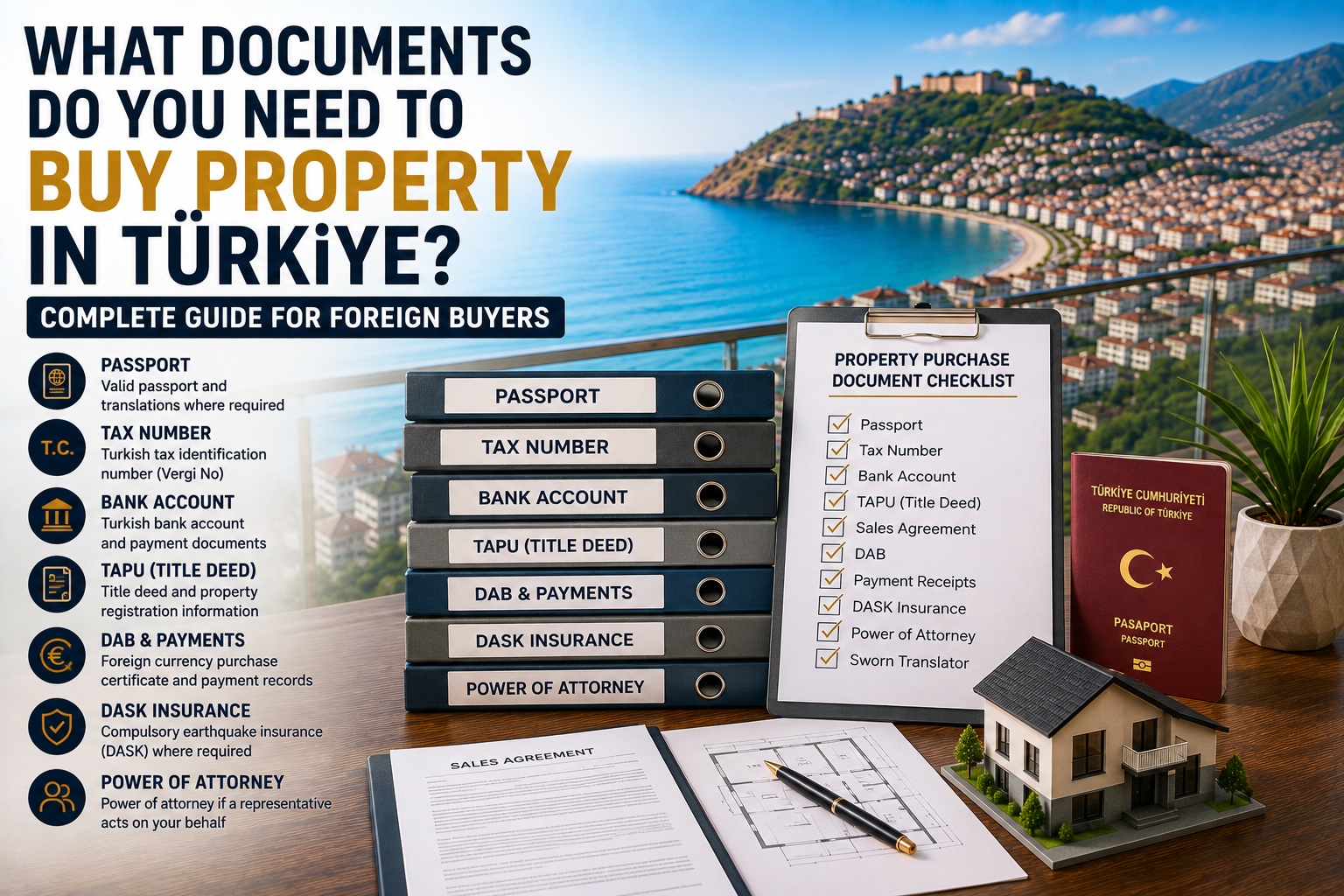
However, a foreign buyer will commonly encounter some or all of the following:
- Valid passport
- Turkish tax identification number
- Turkish bank account or appropriate banking arrangements
- Passport translations where required
- Biometric or passport-style photographs where required
- Property title deed information
- Property-related technical and legal documents
- Foreign currency purchase documentation where applicable
- Payment records
- Earthquake insurance (DASK) where required
- Sworn translator at the title deed transaction where required
- Power of attorney if someone acts on behalf of the buyer
- Additional documentation for residence permit or citizenship applications, if relevant
This list should be treated as a general framework rather than a universal checklist for every transaction.
Requirements can change and individual title deed offices, banks or authorities may request additional documentation depending on the circumstances.
1. Valid Passport
For most foreign buyers, the passport is the primary identification document used during the property purchase process.
The passport details must be consistent across the transaction documents.
Before beginning the purchase process, buyers should check:
- That the passport is valid
- That the name and surname are correctly written
- That the passport number is clearly readable
- That the same identity information is used throughout the transaction
Depending on the procedure, a translated and notarised copy of the passport may be requested.
Buyers should avoid arranging translations unnecessarily in advance without confirming the exact requirement, because the required format may depend on the authority or transaction.
2. Turkish Tax Identification Number
A Turkish tax identification number is one of the basic administrative requirements foreign buyers commonly need in Türkiye.
It may be used for various procedures connected with the purchase, banking, payments, taxes and official registrations.
The tax number should be obtained in the buyer's correct legal name as shown in the passport.
Any spelling inconsistency between the passport, tax registration, banking information and title deed documentation can create unnecessary complications later in the transaction.
3. Does a Foreign Buyer Need a Turkish Bank Account?
A Turkish bank account is commonly useful and, depending on the transaction and payment procedure, can play an important role in completing the purchase.
It can be used for:
- Transferring purchase funds
- Documenting payments
- Managing property-related expenses
- Paying taxes and fees
- Setting up utilities after the purchase
- Receiving rental income in the future
Bank account opening requirements vary between banks and can also differ according to the buyer's nationality, residence status and compliance requirements.
For a detailed explanation, read our complete guide to opening a Turkish bank account as a foreigner.
4. Property Title Deed (TAPU) Information
The title deed, commonly known in Türkiye as the TAPU, is one of the most important documents in a property transaction.
Before buying, the buyer should not simply verify that a title deed exists.
The information connected with the property should be examined carefully.
Depending on the property and transaction, relevant points may include:
- Registered owner
- Province, district and neighbourhood
- Block and parcel information
- Independent section information
- Property type and registered status
- Ownership share
- Mortgages
- Liens
- Annotations
- Restrictions or other registrations affecting the property
A photograph or copy of a TAPU should not by itself be treated as proof that everything relating to the property is legally clear.
The current official records and the circumstances of the transaction should be checked before completion.
Our Property Buying Checklist in Alanya explains the broader checks buyers should consider before committing to a purchase.
5. Property Identification and Technical Documentation
Buying property involves more than checking the owner's identity.
The physical property being purchased should correspond with the relevant official information.
Depending on the building and transaction, documents and information concerning the following may need to be examined:
- Building permit
- Occupancy permit where applicable
- Independent section
- Approved project information
- Building status
- Property characteristics
- Relevant municipal records
The necessary checks differ significantly between a completed resale apartment, a newly completed property and a unit purchased during construction.
6. Documents for Off-Plan and Under-Construction Property
When buying an off-plan property, the documentation is different from purchasing a completed resale apartment.
The buyer is not only evaluating an existing property but also the developer's obligation to deliver something in the future.
Important documentation may therefore include:
- Sales agreement
- Construction and project information
- Technical specifications
- Floor plans
- Payment schedule
- Delivery date
- Conditions relating to delays
- Information about what is included in the purchase price
- Title deed structure
- Developer and land ownership information
Buyers should pay particular attention to the difference between marketing material and legally binding contractual commitments.
For more information, see our guide to buying off-plan property in Alanya, including risks, payment plans and what to check.
7. Sales Agreement
A sales agreement can be one of the most important documents in the transaction, particularly when money is paid before the title deed transfer.
The agreement should accurately identify the parties and the property and clearly explain the commercial terms.
Depending on the transaction, important provisions may include:
- Buyer and seller information
- Property identification
- Agreed purchase price
- Deposit
- Payment schedule
- Currency
- Transfer date
- Possession or delivery date
- Furniture and equipment included
- Responsibilities of the parties
- Conditions relating to default or cancellation
Buyers should understand what they are signing rather than relying only on a verbal explanation of the contract.
8. Deposit and Payment Records
Every significant payment connected with a property purchase should be properly documented.
This is particularly important for:
- Reservation payments
- Deposits
- Instalments
- Developer payments
- Final purchase payments
Payment records can help demonstrate what was paid, when it was paid, by whom it was paid and for what purpose.
Buyers should avoid making substantial payments without understanding the legal and commercial basis of the payment.
9. Foreign Currency Purchase Certificate (Döviz Alım Belgesi / DAB)
Foreign buyers may encounter a document commonly referred to as a Döviz Alım Belgesi (DAB), or foreign currency purchase certificate, as part of the foreign buyer property transaction process.
The applicable procedure should be confirmed for the specific transaction before funds are transferred or converted.
Banking and title deed procedures can be subject to regulatory changes, so buyers should not rely on outdated instructions from an older property transaction.
The sequence of transferring funds, converting currency, documenting the transaction and completing the title deed process should be coordinated correctly.
10. Real Estate Valuation Report
A property valuation report may be relevant or required in certain transactions or related procedures.
Its purpose and legal necessity depend on the nature of the transaction and the applicable regulations at the time.
A valuation report should not be confused with an asking price or an estate agent's market opinion.
These are different concepts and may serve different purposes.
Foreign buyers should confirm whether an official valuation report is required for their particular purchase rather than assuming that the same rule applies to every transaction.
11. DASK — Compulsory Earthquake Insurance
DASK is Türkiye's compulsory earthquake insurance system for qualifying properties.
A valid DASK policy may be required in connection with certain property and utility procedures.
For an existing property, buyers should determine whether a current policy exists and whether a new or updated policy is required as part of the ownership transfer process.
DASK should also be distinguished from broader home insurance.
Compulsory earthquake insurance provides a defined form of coverage; it is not the same as comprehensive household or property insurance.
12. Sworn Translator at the Title Deed Office
If a foreign buyer does not sufficiently understand Turkish for the official title deed transaction, a sworn translator may be required.
The purpose is important: the buyer must understand the official transaction being completed.
The translator explains the relevant content and declarations during the title deed procedure.
Buyers should not treat this as a meaningless administrative formality.
Property ownership is being transferred, so the buyer should understand exactly what is being registered.
13. Power of Attorney
A buyer does not necessarily have to perform every part of the transaction personally.
In appropriate circumstances, a properly prepared power of attorney can authorise another person to perform specified actions on the buyer's behalf.
This can be particularly useful for international buyers who:
- Cannot remain in Türkiye throughout the transaction
- Need someone to complete administrative procedures
- Want a lawyer or another authorised representative to perform specific actions
- Need to complete the purchase after returning to their home country
The wording and scope of the power of attorney are extremely important.
A power of attorney should give the representative the authority actually required for the intended transaction without unnecessarily granting powers unrelated to the buyer's needs.
14. Can a Power of Attorney Be Issued Outside Türkiye?
Depending on the country and procedure, it may be possible to prepare a power of attorney outside Türkiye for use in a Turkish property transaction.
However, the document may need to comply with specific formalities concerning notarisation, apostille or consular procedures, translation and acceptance in Türkiye.
Because these requirements can depend on the country where the document is issued, buyers should confirm the correct procedure before signing it abroad.
Preparing a document in the wrong form can cause delays when it is later presented in Türkiye.
15. Do You Need a Residence Permit to Buy Property in Türkiye?
Foreign ownership of property and residence permission are separate legal concepts.
A foreign buyer does not generally purchase a property simply by presenting a Turkish residence permit.
Likewise, buying a property should not automatically be understood as guaranteeing a particular residence status.
The rules governing residence permits depend on the applicable immigration regulations and the buyer's circumstances.
If residence is part of your purchasing objective, read our guide to residence permits through property purchase in Türkiye and our broader explanation of property purchase, residence permits and Turkish citizenship.
16. Documents for Turkish Citizenship by Investment
If the property purchase is intended to form part of a Turkish citizenship application, additional rules and documentation may apply.
A standard property purchase and a property purchase structured for a citizenship application should not be treated as identical transactions.
The buyer may need to consider issues such as:
- Applicable investment threshold
- Official valuation requirements
- Payment documentation
- Banking records
- Title deed annotations
- Restrictions on resale for the required period
- Eligibility of the property and transaction
If citizenship is an objective, this should be identified before the purchase is structured and completed, not after the title deed has already been transferred.
See our guide to buying property in Türkiye for residence permit and Turkish citizenship purposes.
17. Does the Buyer Need to Be in Türkiye for the TAPU Transfer?
Not necessarily in every case.
A buyer may personally attend the title deed transaction, or an appropriately authorised representative may be able to act under a valid power of attorney.
This can make remote transactions possible in suitable circumstances.
However, buyers should distinguish between:
- Viewing a property remotely
- Signing a reservation document remotely
- Making payments remotely
- Completing legal due diligence remotely
- Completing the official title deed transfer through an authorised representative
Each step carries different practical and legal considerations.
18. What Documents Should You Request From the Seller?
The buyer's documents are only half of the transaction.
The seller and the property must also be verified.
Depending on the transaction, the buyer or the professionals acting for the buyer may need to examine information concerning:
- Seller's identity
- Ownership
- Current title deed records
- Mortgages and liens
- Annotations and restrictions
- Property status
- Building documentation
- Outstanding property-related obligations where relevant
- Authority to sell if a representative is acting for the seller
The fact that someone has access to a property or advertises it for sale does not itself establish legal ownership or authority to sell.
19. What Documents Should You Check When Buying From a Developer?
Buying directly from a developer requires a different type of review.
In addition to the specific unit, buyers should understand the legal and commercial structure of the development.
Relevant documentation can include:
- Developer company information
- Land ownership
- Construction permissions
- Project plans
- Technical specifications
- Sales agreement
- Payment schedule
- Expected delivery date
- Title deed arrangements
- Conditions for delays or changes
A beautiful showroom, brochure or computer rendering is marketing material.
It should not replace documentary due diligence.
20. What Should Be Checked Before Paying a Deposit?
Foreign buyers sometimes focus on documentation only immediately before the TAPU transfer.
That can be too late.
Important checks should begin before a substantial deposit or reservation payment is made.
Before paying, buyers should understand at minimum:
- Who is receiving the money
- Why the payment is being made
- Which property is being reserved
- Whether the payment is refundable
- Under what circumstances it may be retained
- The agreed purchase price
- The next stages of the transaction
A written record is substantially stronger than relying on verbal promises.
21. Documents and Costs Should Be Reviewed Together
Documentation and financial planning should not be treated as separate subjects.
Different stages of a purchase can involve taxes, title deed charges, insurance, translation, professional services and other transaction expenses.
A buyer should therefore calculate the total acquisition budget rather than focusing only on the advertised property price.
Our detailed guide to property taxes and buying costs in Alanya explains the main expenses foreign buyers should consider.
22. Keep Copies of All Important Documents
Buyers should maintain an organised transaction file containing relevant documents and records.
This may include:
- Contracts
- Passport and identity documents used in the transaction
- Tax information
- Bank transfer receipts
- Deposit receipts
- Official payment documents
- Valuation documents where applicable
- Insurance documents
- Power of attorney where applicable
- Final title deed documentation
- Invoices and receipts
Keeping a complete record can be useful not only during the purchase but also later for tax, resale, insurance, residence, banking or other administrative matters.
23. Check Names, Numbers and Property Details Carefully
One of the simplest but most important parts of document control is checking basic information.
Before signing or approving important documents, verify:
- Your full legal name
- Passport number
- Tax number
- Seller information
- Property block and parcel
- Independent section number
- Purchase price
- Payment amounts
- Currency
- Important dates
A small clerical mistake can create unnecessary delays or disputes later.
24. Do Not Sign Documents You Do Not Understand
This rule is particularly important when purchasing property in another country.
Buyers may receive documents in Turkish or bilingual contracts containing legal and technical terminology.
Do not sign simply because someone says that a document is “standard.”
A standard document can still create important obligations.
If you do not understand a provision, ask for an explanation and, where appropriate, obtain independent professional advice before signing.
25. A Practical Document Checklist for Foreign Buyers
Before completing a property purchase in Türkiye, use the following as a practical starting checklist:
- Check that your passport is valid.
- Obtain the necessary Turkish tax identification information.
- Arrange appropriate banking facilities.
- Confirm how purchase funds will be transferred and documented.
- Obtain current title deed information for the property.
- Verify the seller and ownership.
- Check mortgages, liens, annotations and restrictions where relevant.
- Review the property's legal and technical status.
- Review the sales agreement before paying substantial funds.
- Document deposits and other payments.
- Confirm the applicable foreign currency/DAB procedure.
- Confirm whether an official valuation is required.
- Arrange DASK where applicable.
- Arrange a sworn translator if required.
- Prepare a power of attorney correctly if someone will act for you.
- Confirm additional requirements if residence or citizenship is part of the purchase objective.
- Check all names, numbers, amounts and dates before signing.
- Keep copies of the complete transaction file.
Common Documentation Mistakes Foreign Buyers Should Avoid
Many problems can be prevented with relatively simple preparation.
Common mistakes include:
- Transferring a large deposit before checking the property
- Assuming a TAPU copy proves the property is legally clear
- Using inconsistent name spellings across documents
- Relying on verbal promises that do not appear in the contract
- Not documenting payments
- Using an overly broad or incorrectly drafted power of attorney
- Assuming an old purchase procedure is still current
- Confusing a marketing brochure with contractual specifications
- Ignoring mortgages, liens or annotations
- Signing a document without understanding its contents
- Waiting until the title deed appointment to begin due diligence
Buying a Resale Property vs a New-Build Property
The documentation process also depends on what you are buying.
With a resale property, much of the due diligence concerns the existing title, building, apartment, seller and current physical condition.
With a new-build or off-plan purchase, more attention may be required regarding the developer, construction status, specifications, delivery obligations and payment plan.
If you are deciding between the two, read our comparison of new-build vs resale property in Alanya.
How Does the Complete Buying Process Work?
Documents make more sense when they are viewed as part of the overall purchasing process.
A typical transaction may move through stages such as:
- Property search and comparison
- Viewing and selection
- Price negotiation
- Initial document review
- Agreement on commercial terms
- Deposit or reservation where appropriate
- Legal and technical checks
- Banking and payment arrangements
- Preparation for the title deed transaction
- TAPU transfer
- Handover and post-purchase procedures
For the full process, see our step-by-step guide to buying property in Alanya as a foreign buyer.
Should You Negotiate Before Preparing All Documents?
Yes. Buyers can usually negotiate the commercial terms before every administrative document is complete.
However, there is an important distinction between negotiating a price and becoming financially or legally committed to the transaction.
Before substantial payments are made, the relevant checks and documentation should reach an appropriate level for the specific transaction.
If you are preparing an offer, our guide to negotiating property prices in Alanya explains how to structure the commercial side of the purchase.
Final Thoughts: Good Documentation Protects the Transaction
Buying property in Türkiye does not have to be administratively complicated.
What matters is that the right documents are prepared and checked at the right time.
For a foreign buyer, the strongest transaction is not simply one where the TAPU is eventually transferred.
It is a transaction where the buyer understands:
- Who owns the property
- What exactly is being purchased
- What is registered officially
- What the contract requires
- How and when money is being paid
- Which documents support those payments
- What additional obligations or restrictions may exist
At M² Real Estate, we believe documentation should be treated as part of the buying strategy from the beginning, rather than as paperwork to be dealt with only at the final title deed appointment.
Foreign buyers should understand the transaction before committing significant funds and should obtain appropriate professional assistance whenever legal, tax or technical questions require specialist advice.
Before purchasing, you can also use our complete property buying checklist for Alanya to review the wider legal, financial and practical points surrounding a property purchase.
Important: Property purchase procedures, banking requirements, title deed procedures, foreign exchange rules, residence regulations and other administrative requirements in Türkiye can change. This article provides general information and does not constitute legal, tax, financial or immigration advice. The requirements applicable to a specific buyer and property should be confirmed with the relevant authorities and qualified professionals before completing a transaction.
Share this post: