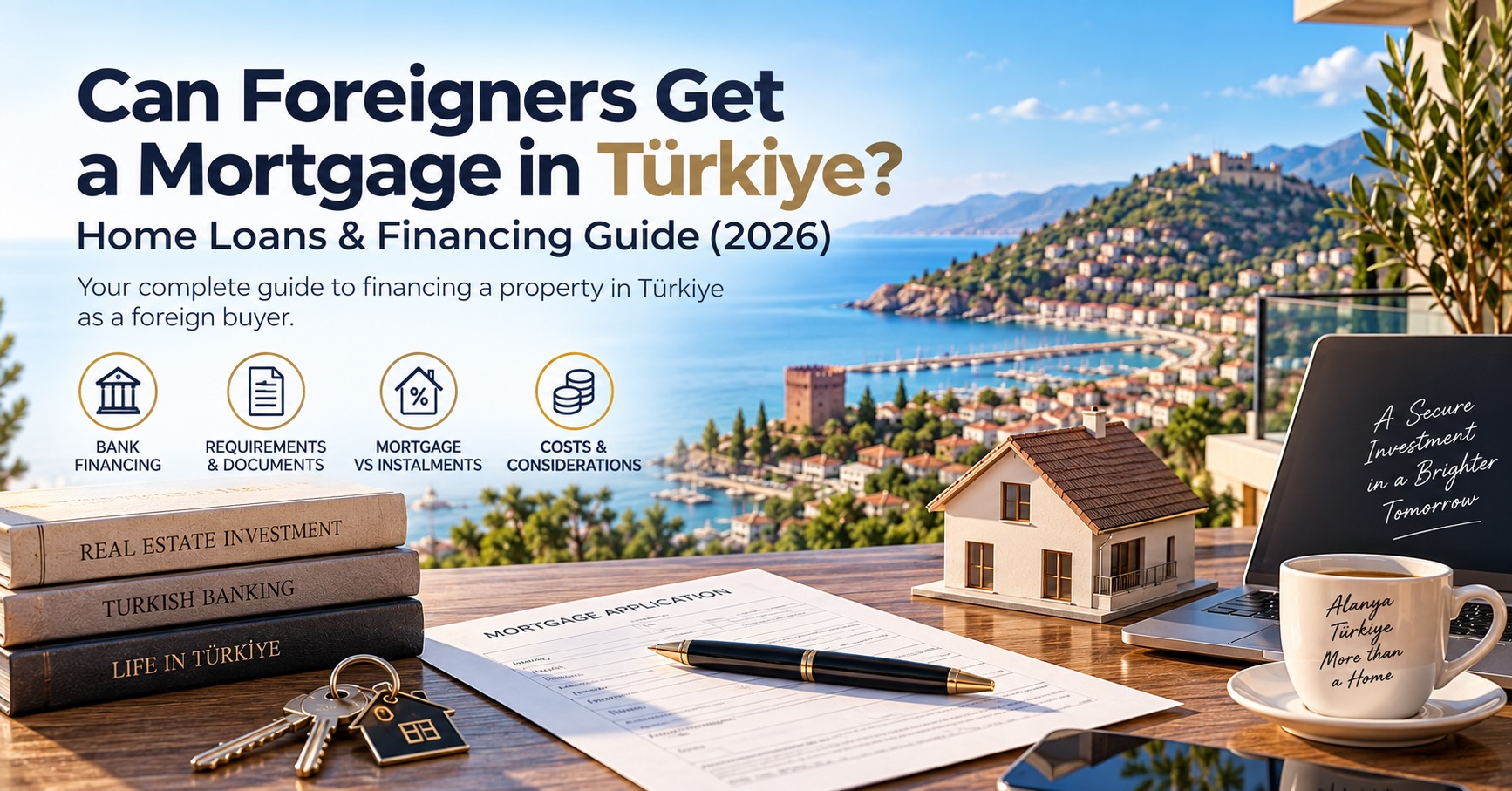
Can Foreigners Get a Mortgage in Türkiye? Home Loans & Property Financing Guide (2026)
Buying property in Türkiye does not always mean paying the entire purchase price in cash. Depending on the buyer, the property and the lender, foreign nationals may be able to obtain mortgage or housing finance from a Turkish bank.
However, getting a mortgage in Türkiye as a foreign buyer is not automatic. Banks assess each application individually, and lending policies can vary significantly depending on nationality, residency, income, the property being purchased and current banking conditions.
There is also another financing method frequently encountered in the Turkish property market: developer payment plans, particularly for new-build and off-plan properties.
In this 2026 guide, we explain how property financing in Türkiye works for foreign buyers, what documents may be requested and what you should consider before deciding between a bank mortgage, developer instalments or a cash purchase.
Can Foreigners Get a Mortgage in Türkiye?
Yes, mortgage and housing finance products can be available to foreign nationals in Türkiye. However, eligibility and lending conditions are determined by the individual bank.
A bank will normally evaluate two separate things:
- The borrower – income, financial profile, nationality, residency and repayment capacity
- The property – value, legal status, location and suitability as security for the loan
Being legally eligible to buy property in Türkiye does not automatically mean that a bank will approve financing.
If you are at the beginning of your property search, our step-by-step guide to buying property in Alanya as a foreigner explains the overall purchasing process.
How Does a Turkish Mortgage Work?
A housing loan is generally secured against the property being purchased.
The basic structure is relatively straightforward:
- The buyer selects a suitable property.
- The buyer applies to the bank for financing.
- The bank evaluates the buyer's financial position.
- The property is professionally valued.
- The bank determines whether the property and borrower meet its lending criteria.
- If approved, the loan conditions and repayment plan are established.
- A mortgage is registered over the property as security for the bank.
The mortgage remains associated with the property until the relevant debt is repaid and the mortgage is formally released.
How Much Can a Foreigner Borrow?
There is no single percentage that applies to every foreign buyer.
The amount a bank is willing to finance can depend on:
- The bank's current lending policy
- The buyer's nationality and residency status
- Documented income
- Existing financial obligations
- The appraised value of the property
- The type and condition of the property
- The requested loan term
- Current banking and regulatory rules
One of the most important points for buyers to understand is that the bank normally bases its financing decision on its accepted appraisal value rather than simply the advertised or negotiated selling price.
Example: Purchase Price vs Appraised Value
Imagine that you agree to purchase an apartment for €250,000.
This does not mean the bank will automatically calculate the mortgage based on €250,000.
If the property's accepted appraisal is lower, the bank may calculate the available financing using that valuation and its applicable lending criteria.
The buyer must therefore have sufficient own funds to cover:
- The portion of the purchase price not financed by the bank
- Any difference between the agreed price and the value accepted by the lender
- Taxes and transaction expenses
- Other costs associated with the purchase and financing
This is one reason why buyers should establish their financing capacity before committing to a property that depends on mortgage approval.
Does the Bank Require a Property Valuation?
Property valuation is an important part of mortgage financing.
The lender needs to determine the value and suitability of the property that will secure the loan.
The valuation may consider factors such as:
- Location
- Property type
- Size
- Physical condition
- Comparable properties
- Legal and title deed information
- Construction status
The valuation is therefore not simply a confirmation of the seller's asking price.
What Documents May Foreign Buyers Need?
Requirements vary between banks, but foreign applicants may be asked for documents relating to their identity, income and financial position.
Depending on the bank and applicant, these may include:
- Passport
- Turkish tax identification information where required
- Proof of address
- Residence information where applicable
- Employment documents
- Salary or income statements
- Bank statements
- Documents relating to existing loans or liabilities
- Company or business documents for self-employed applicants
- Documents relating to the property being purchased
Documents issued abroad may also require translation, notarisation, apostille or other certification depending on the bank and country of issue.
For the wider property transaction, see our guide to the documents foreigners may need when buying property in Türkiye.
Do You Need a Turkish Residence Permit to Get a Mortgage?
There is no useful one-size-fits-all answer because bank policies differ.
Some financing products may be available to non-resident foreign buyers, while other products or banks may impose residency-related requirements.
This distinction is important:
Eligibility to purchase property and eligibility for a particular bank loan are separate questions.
A foreign national may be legally entitled to purchase a property while still not satisfying a particular bank's credit requirements.
Does a Foreigner Need a Turkish Bank Account?
In practice, banking becomes an important part of many property transactions involving foreign buyers, particularly when financing is involved.
A Turkish bank account may be needed or useful for:
- Loan repayments
- Transferring purchase funds
- Paying property-related expenses
- Utility payments after purchase
- Managing the property from abroad
If you do not yet have one, see our complete 2026 guide to opening a Turkish bank account as a foreigner.
Can You Get a Mortgage in Turkish Lira?
Turkish-lira housing finance is part of the domestic lending market, but the exact products available to a foreign buyer depend on the lender and the applicant's circumstances.
Foreign buyers should not compare loans only by the headline interest or profit rate.
The complete financing structure should be considered, including:
- Currency
- Loan amount
- Loan term
- Monthly payment
- Total repayment
- Bank fees
- Valuation expenses
- Insurance or other applicable costs
- Currency risk where relevant
Currency Risk Is Especially Important for Foreign Buyers
A buyer earning euros, pounds or another currency should consider the relationship between the currency of income, the currency of the loan and the Turkish lira.
Exchange rates can move substantially during a multi-year loan.
For that reason, the cheapest-looking monthly payment today is not necessarily the lowest-risk financing structure over the full term.
Foreign buyers should evaluate financing in the context of their own income currency and long-term financial position.
Mortgage vs Developer Payment Plan
Bank financing is not the only way to spread the cost of buying property in Alanya.
Many new developments offer developer payment plans.
A typical structure may involve:
- An initial deposit or down payment
- Instalments during construction
- A final payment at completion or handover
The exact arrangement varies considerably from project to project.
Some developers may advertise interest-free instalments over a defined construction period. However, buyers should compare the total property price and contractual terms rather than focusing only on the phrase “interest-free”.
When Can a Developer Payment Plan Make Sense?
Developer financing can be attractive when:
- You are buying a new-build or off-plan property
- You have a substantial deposit but prefer not to pay the full price immediately
- The payment schedule matches your expected cash flow
- You prefer a shorter instalment period instead of a long bank loan
- The commercial terms are competitive
However, developer instalments and bank mortgages involve different risks.
A bank is lending against a property under its own credit and collateral procedures. With an off-plan payment plan, the buyer is making payments under a purchase contract while the project may still be under construction.
For this reason, project and contract checks become particularly important.
Read our guide to buying off-plan property in Alanya before considering this type of purchase.
Mortgage vs Developer Instalments: Key Differences
| Bank Mortgage | Developer Payment Plan |
|---|---|
| Provided by a bank | Provided directly through the project/developer |
| Credit assessment required | Commercial approval may be simpler |
| Property valuation generally important | Usually based on the project's sales terms |
| Can involve longer repayment periods | Usually shorter repayment schedule |
| Mortgage registered as security | Security depends on contract and ownership structure |
| Interest/profit and banking costs may apply | Some projects offer instalments without separately stated interest |
Neither option is automatically better. The right structure depends on the property, price, buyer's finances and contractual terms.
Cash Purchase vs Mortgage: Which Is Better?
For buyers who already have sufficient capital, paying cash can simplify the transaction and eliminate financing costs.
It can also strengthen the buyer's negotiating position in some transactions.
Financing, however, allows the buyer to retain part of their capital instead of placing the full amount into one property.
The decision should therefore be based on more than whether a loan is available.
Consider:
- Total financing cost
- Alternative use of your capital
- Currency risk
- Monthly cash flow
- Investment horizon
- Negotiating advantage of a cash purchase
Can You Negotiate the Property Price If You Need Financing?
Yes, but the financing structure can influence negotiations.
A seller may value certainty and speed, while a mortgage-dependent transaction can involve additional steps such as valuation and bank approval.
Buyers should therefore be transparent about the intended financing structure when making an offer.
For practical negotiation strategies, see our guide to negotiating property prices in Alanya.
Do Not Forget the Costs Outside the Mortgage
Financing part of the purchase price does not eliminate the other expenses associated with buying property.
Depending on the transaction, buyers should budget for applicable:
- Title deed and transaction costs
- Taxes and official charges
- Property valuation
- Translation and notarisation
- Insurance
- Bank-related financing expenses
- Professional services where required
Our 2026 guide to property taxes and buying costs in Alanya explains the wider transaction costs in more detail.
Should You Apply for Financing Before Choosing a Property?
If mortgage financing is essential to your purchase, it is sensible to understand your approximate borrowing capacity before making a firm commitment.
This helps answer three important questions:
- How much capital do you need to contribute yourself?
- What price range is realistically affordable?
- Which types of property are likely to fit the lender's requirements?
A buyer who searches for property first and investigates financing only after paying a substantial deposit may create unnecessary risk.
Be Careful With Reservation Deposits
If your purchase depends on obtaining financing, this should be considered before paying a significant reservation or deposit.
The written terms should clearly explain what happens if the required financing cannot be obtained.
Do not assume that a deposit will automatically be refundable simply because a bank declines the loan.
Before committing significant funds, also consider the legal and title checks explained in our Alanya property buying checklist and our guide to checking a property in Türkiye before buying.
Can You Finance an Off-Plan Property With a Bank Mortgage?
This depends on the property, its construction stage, title status and the lender's criteria.
A bank needs acceptable security for its financing. A property that has not yet reached the required legal or physical stage may therefore be treated differently from a completed apartment with an established title structure.
This is another reason developer instalment plans are commonly encountered in new developments.
What About New-Build vs Resale Property?
The financing experience can differ depending on whether you buy a completed resale apartment or a newly built property.
A resale property already has an ownership and building history that can be reviewed, while a new development may offer more flexible payment plans directly from the developer.
If you have not yet decided which route is suitable, read our New Build vs Resale Property in Alanya guide.
Can a Property With a Mortgage Be Sold Later?
A mortgage registered over a property does not mean the owner can never sell it.
However, the outstanding secured debt and mortgage must be properly dealt with as part of the sale process.
The exact procedure depends on the bank, debt and transaction structure.
Foreign owners considering a future resale can also read our guide to selling property in Alanya as a foreign owner.
Important: Financing Does Not Replace Property Due Diligence
A bank approving financing should not be treated as a substitute for the buyer's own property checks.
Before purchasing, buyers should still understand matters such as:
- Who legally owns the property
- The title deed status
- Mortgages, liens or restrictions
- Whether the physical property matches the official records
- Building and occupancy documentation where relevant
- The purchase contract
Financing answers the question “Can this purchase be funded?”
Due diligence answers a different question: “Should I safely proceed with this particular property and transaction?”
A Practical Financing Strategy for Foreign Buyers
- Determine your total property budget.
- Decide how much cash you want to contribute.
- Speak with banks before relying on mortgage financing.
- Compare mortgage and developer payment options.
- Choose properties that fit both your budget and financing structure.
- Check the property before paying a substantial deposit.
- Calculate the full purchase cost, not only the property price.
- Review currency and repayment risk.
- Complete the required bank and property documentation.
- Proceed with the title deed transfer once the transaction structure is clear.
Frequently Asked Questions
Can a foreigner get a mortgage in Türkiye?
Yes. Housing finance can be available to foreign nationals through Turkish banks, but approval and conditions depend on the lender, applicant and property.
Can a non-resident get a mortgage in Türkiye?
Potentially, depending on the bank and its current lending criteria. Residency requirements vary between institutions and products.
How much deposit does a foreign buyer need?
There is no universal percentage. The required buyer contribution depends on the bank's lending criteria, the property's accepted appraisal value and the purchase price.
Can I get a mortgage for an apartment in Alanya?
Potentially yes, provided both the applicant and the property meet the lender's requirements.
Does the bank finance the selling price of the property?
Not necessarily. The lender normally considers an accepted professional valuation together with its own lending limits and criteria.
Do I need a Turkish bank account?
A Turkish banking relationship is generally important when obtaining local financing and making loan repayments. Exact requirements depend on the lender.
Are developer payment plans the same as mortgages?
No. A mortgage is financing provided by a financial institution and secured against property. A developer payment plan is a contractual instalment arrangement connected to the property sale.
Is an interest-free developer payment plan always cheaper?
Not necessarily. Buyers should compare the total property price, payment schedule and contractual terms rather than evaluating only whether separately stated interest is charged.
Should I pay a deposit before mortgage approval?
If the purchase depends on financing, buyers should be cautious about making a substantial non-refundable payment before understanding their financing position and the deposit conditions.
Final Thoughts
Foreign buyers do not necessarily need to purchase property in Türkiye entirely with cash. Depending on individual circumstances, bank mortgage financing or developer payment plans may provide alternative ways to structure the purchase.
The most important point is not simply whether financing is available, but whether the financing structure makes sense for the buyer.
Before deciding, compare:
- The amount you need to finance
- The total repayment cost
- Your income currency
- The required down payment
- The property valuation
- The repayment period
- Developer alternatives
- The overall legal and financial structure of the purchase
Planning to buy property in Alanya? M² Real Estate can help you identify suitable properties and understand the available purchase and payment structures before you commit to a transaction.
This article is provided for general information only. Mortgage availability, lending criteria, rates, loan-to-value limits and banking requirements can change and are determined by the relevant financial institution. The content does not constitute financial, legal or tax advice.
Share this post: