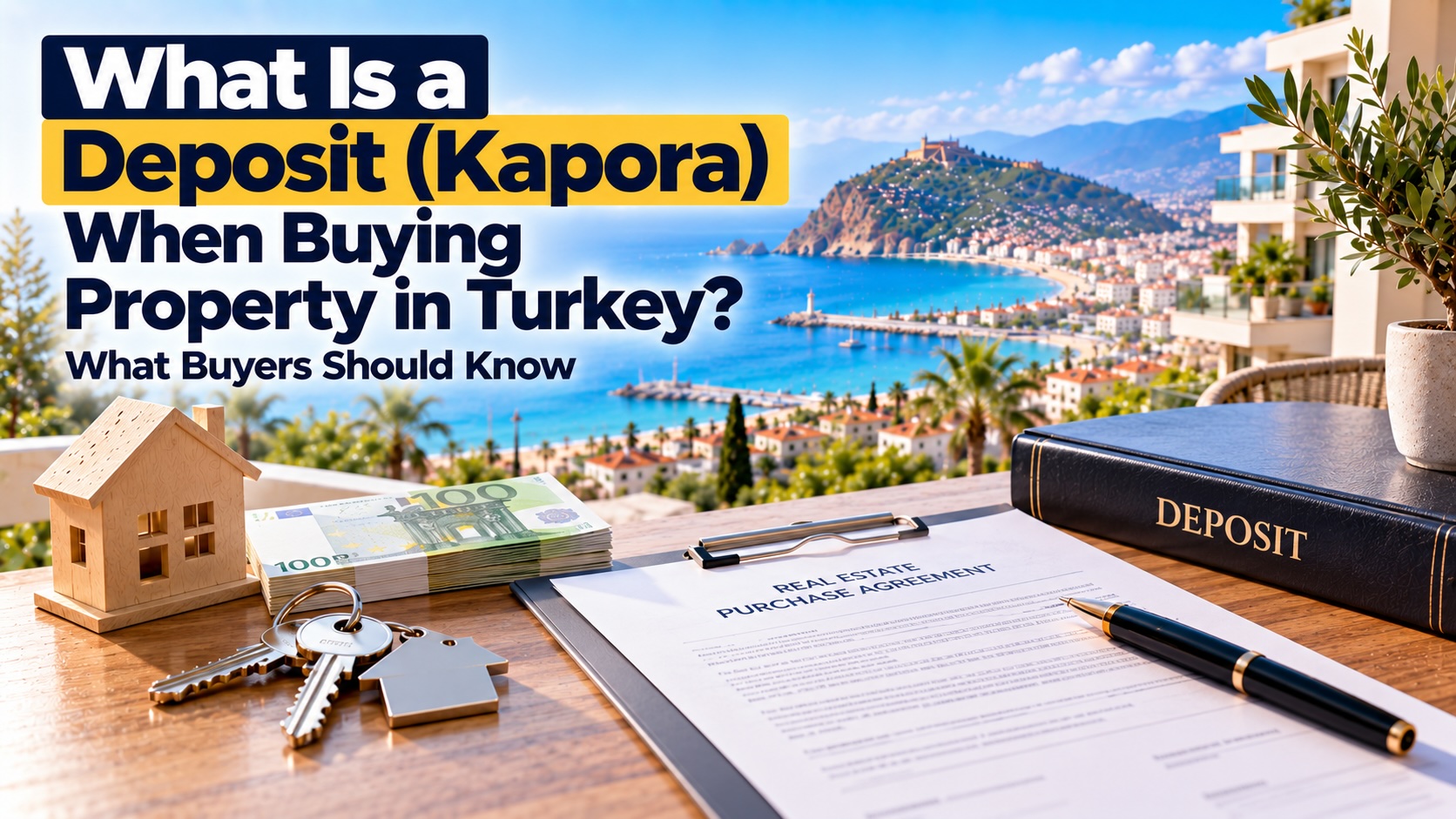
What Is a Deposit (Kapora) When Buying Property in Turkey? What Buyers Should Know
Short answer: In Turkey, buyers commonly use the word kapora for money paid to show serious intention to purchase a property and to move the transaction forward. However, “kapora” is an everyday commercial term rather than a single legal category with one automatic result. Under Turkish law, money paid when a contract is concluded may qualify as bağlanma parası (binding money), while parties can separately agree on cayma parası (withdrawal money). The legal consequences are different, so buyers should never rely only on the word “deposit”. The written terms of the transaction matter.
What Does Kapora Mean When Buying Property in Turkey?
In Turkish property transactions, kapora generally refers to an initial amount paid before completion of the purchase.
In practice, it may be used to demonstrate that the buyer is serious, confirm agreed commercial terms, move the transaction toward completion or temporarily take the property off active marketing under agreed conditions.
But the word itself does not tell you everything about the legal consequences of the payment.
This distinction is particularly important for foreign buyers because terms such as “deposit”, “reservation payment”, “down payment”, bağlanma parası and cayma parası can be used differently in everyday conversations.
Is Kapora a Legal Term in Turkey?
The important legal concepts are found in the Turkish Code of Obligations.
Article 177 regulates bağlanma parası. Under the general rule, money given when a contract is concluded is considered evidence that the contract has been made rather than withdrawal money. Unless otherwise agreed or established by local custom, that amount is deducted from the principal obligation.
Article 178 separately regulates cayma parası, meaning money specifically agreed as giving the parties a right to withdraw.
Therefore, simply writing or saying “kapora” is not the safest way to define the parties' rights.
What Is Bağlanma Parası?
Bağlanma parası can be understood as money given in connection with the conclusion of a contract and serving, under the statutory rule, as evidence that the contract has been made.
Unless the parties agree otherwise or a relevant local custom applies, it is deducted from the principal amount owed.
For example, if the parties clearly document that an amount is paid toward the agreed purchase price, the payment should also be recorded in the transaction documents and accounted for when the remaining balance is calculated.
What Is Cayma Parası?
Cayma parası is legally different.
If the parties specifically agree on withdrawal money under Article 178 of the Turkish Code of Obligations, each party is considered entitled to withdraw from the contract under that arrangement.
Under the statutory rule, if the party who paid the withdrawal money withdraws, that party leaves the payment with the other party. If the party who received it withdraws, that party returns twice the amount received.
This rule should not automatically be applied to every payment casually described as “kapora”. The nature of the payment and the agreement between the parties must first be established.
Does Paying a Deposit Mean You Own the Property?
No.
Paying a deposit does not transfer ownership of real estate in Turkey.
Property ownership is transferred through the legally required official title deed process. Turkish law also imposes formal requirements on contracts for the sale of real estate.
A private deposit or reservation document should therefore not be confused with the actual transfer of title.
For the complete procedure, see our guide to the title deed transfer process in Türkiye.
What Should Be Written Before Paying a Property Deposit?
A buyer should be able to identify exactly what the payment relates to. Depending on the transaction, the written document should clearly address relevant points such as:
- full identification of the buyer and seller;
- clear identification of the property;
- agreed sale price;
- amount paid;
- currency of the payment;
- date and method of payment;
- whether the amount will be deducted from the agreed price;
- the purpose and legal character intended for the payment;
- conditions for refund or retention;
- what happens if the buyer does not proceed;
- what happens if the seller does not proceed;
- important conditions that must be satisfied before completion;
- expected timetable for the next stage of the transaction.
The exact wording should reflect the actual transaction rather than using a generic template without understanding its consequences.
Should You Pay Kapora Before Checking the Property?
Buyers should be cautious about making a substantial payment before essential information about the property and the person receiving the money has been verified.
The appropriate level of checking depends on the transaction, but relevant questions can include:
- Who is the registered owner?
- Does the person receiving the money have authority to receive it?
- Does the property correspond to the property being advertised and shown?
- Are there title deed or legal issues relevant to the purchase?
- Are the agreed price and payment schedule clearly documented?
- Are any important buyer conditions still outstanding?
For a broader review, read our property due diligence guide for Turkey.
Who Should Receive the Deposit?
This should be clear before any transfer is made.
The buyer should know exactly who is receiving the money and on what legal or contractual basis. If payment is made to someone other than the registered owner, the authority and role of that recipient should be established and documented.
Never assume that a bank account, name sent through a messaging application or verbal instruction is sufficient proof of authority.
Cash or Bank Transfer?
From an evidence and record-keeping perspective, a traceable payment method generally provides a clearer transaction record than an undocumented cash payment.
Where a bank transfer is used, the parties should make sure the payment description corresponds accurately to the transaction and the written documentation.
Buyers should also keep the receipt, transfer confirmation and relevant signed documents.
For larger property payments and the wider purchase process, see our guide to paying for property in Türkiye as a foreign buyer.
How Much Kapora Should a Buyer Pay?
There is no single universal percentage that should automatically be treated as the correct deposit for every property transaction.
The amount can depend on the purchase price, transaction structure, negotiations, seller and buyer agreement, and the stage of the transaction.
Rather than focusing only on the percentage, buyers should ask a more important question: What exactly happens to this money under each possible outcome?
What Happens if the Buyer Changes Their Mind?
There is no safe universal answer based solely on the word “kapora”.
The result depends on the legal character of the payment, the agreement between the parties, the reason the transaction did not proceed and other circumstances.
If genuine cayma parası has been agreed, Article 178 contains a specific statutory consequence. But a payment that constitutes bağlanma parası, an advance payment or another contractual payment should not automatically be treated in the same way.
What Happens if the Seller Changes Their Mind?
The same caution applies.
The statement “the seller always pays double the deposit” is too broad and can be misleading.
The double-return rule is specifically associated with cayma parası under Article 178. Whether that rule applies depends on how the payment and the parties' rights were legally structured.
This is why a properly drafted document is much safer than relying on verbal assumptions about what “kapora” means.
Is a Deposit Agreement the Same as a Property Sale Contract?
No.
This is one of the most important distinctions for foreign buyers.
Turkish law requires an official form for the valid sale of real estate. A privately signed deposit, reservation or preliminary document does not itself transfer property ownership.
Formal requirements can also apply to agreements intended to create enforceable rights concerning a future real estate sale.
Therefore, the legal effect of a private document should be assessed separately from the actual title deed transfer.
What if the Property Has a Legal Problem After Paying the Deposit?
This is precisely why important buyer conditions should be addressed before payment or clearly written into the relevant agreement.
Depending on the transaction, a buyer may want completion to depend on satisfactory checks concerning title records, authority to sell, building documentation or other material issues.
Our property buying checklist for Alanya provides a broader overview of matters to review before completing a purchase.
Should the Property Be Taken Off the Market After Kapora?
This should not be assumed.
If removing the property from active marketing is an important part of the arrangement, that point should be expressly agreed between the relevant parties.
The document should make clear what has been agreed rather than leaving both sides with different expectations.
Common Mistakes Foreign Buyers Should Avoid
- Paying money before identifying the recipient and their authority.
- Relying only on WhatsApp messages or verbal promises.
- Using the word “deposit” without defining what happens if the transaction fails.
- Assuming every kapora automatically gives the buyer a right to withdraw.
- Assuming every seller who withdraws automatically owes double.
- Failing to identify the property precisely.
- Failing to state whether the payment is part of the purchase price.
- Making a large payment before appropriate property checks.
- Confusing a private deposit document with the official title transfer.
A Practical Kapora Checklist for Property Buyers
- Identify the exact property.
- Confirm who owns it.
- Verify who is authorised to receive the payment.
- Agree the total purchase price.
- Define the amount and currency of the deposit.
- Define what the payment legally and commercially represents.
- Write down refund and withdrawal conditions.
- Record how the payment affects the remaining purchase price.
- Use a traceable payment method where appropriate.
- Keep all signed documents and payment records.
- Complete appropriate due diligence before the transaction progresses too far.
Frequently Asked Questions
What is kapora in Turkish real estate?
Kapora is the commonly used Turkish term for an initial payment connected with a transaction. Its exact legal effect depends on how the payment and agreement are structured.
Is kapora automatically refundable?
No universal rule can be applied simply because a payment is called kapora. The legal character of the payment, written terms and circumstances must be considered.
Does the seller always return double the kapora?
No. The statutory double-return rule applies to cayma parası under Article 178 of the Turkish Code of Obligations. It should not automatically be applied to every payment called kapora.
Is kapora deducted from the property price?
For bağlanma parası, Article 177 provides that it is deducted from the principal obligation unless otherwise agreed or local custom provides otherwise. The transaction documents should state clearly how the payment will be accounted for.
Does paying kapora reserve the property automatically?
Buyers should not assume so. If the seller is expected to stop marketing the property, this should be expressly included in the arrangement.
Can I become the owner by signing a deposit agreement?
No. A private deposit agreement does not itself transfer ownership of real estate in Turkey. Ownership transfer requires the legally prescribed official procedure.
Final Thoughts
Kapora is common in Turkish property transactions, but the amount of the deposit is not the most important issue. The most important issue is what the payment means and what the parties have actually agreed.
For foreign buyers considering property for sale in Alanya, a clear written record, verification of the recipient, appropriate property checks and precisely defined refund or withdrawal conditions can prevent serious misunderstandings.
Before you buy an apartment in Alanya, do not treat the payment of a deposit as a substitute for due diligence or the official title deed process.
This article provides general information and does not constitute individual legal advice. The legal consequences of a deposit depend on the wording of the agreement and the circumstances of the specific transaction.
Share this post: